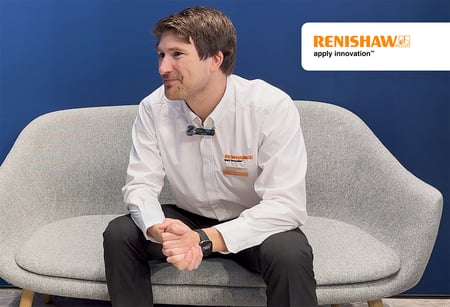
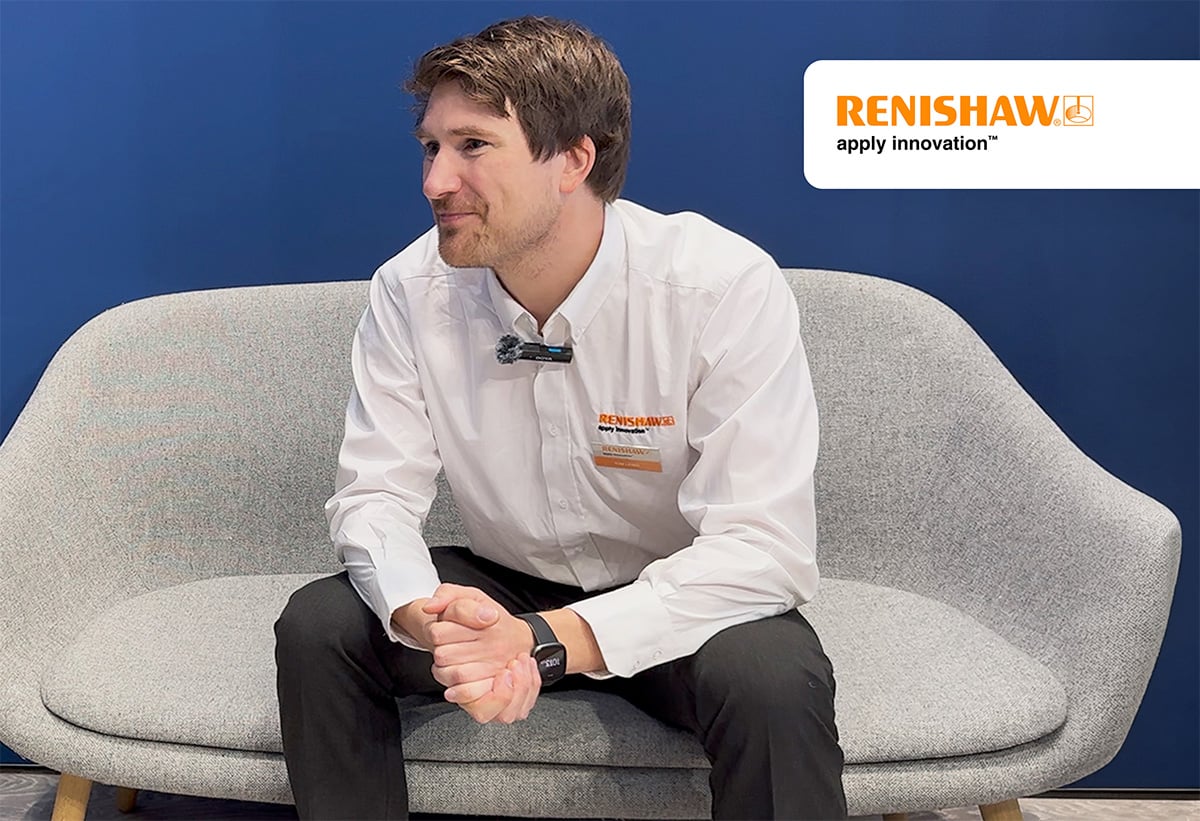

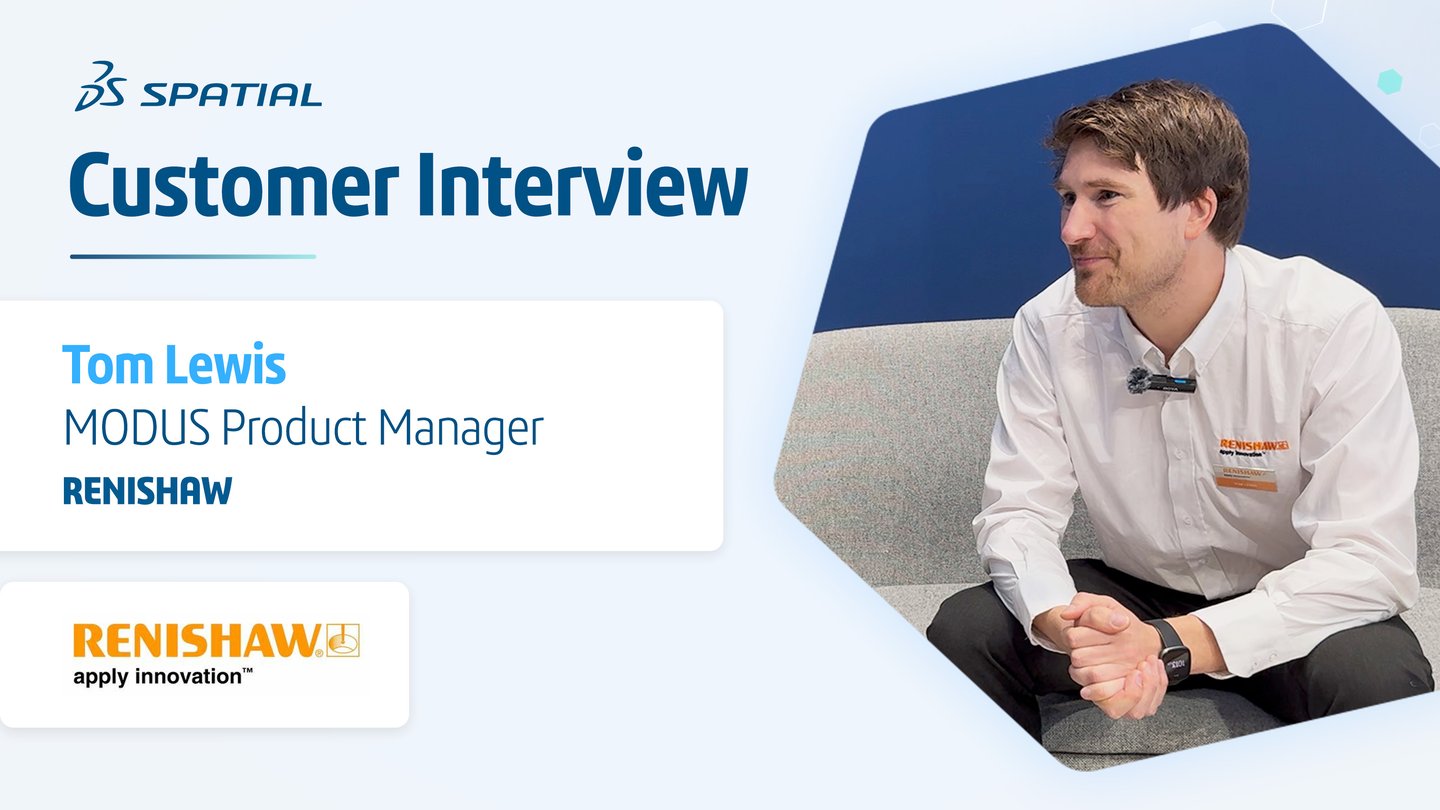
Tom Lewis, Product Manager of MODUS™ IM software at Renishaw, introduced the two major launches the company brought to EMO 2025: the new Equator X gauging system and the MODUS™ IM inspection software that drives it, alongside Renishaw's Agility CMMs and existing Equator range.
Starting life as a probing company over 50 years ago, Renishaw has built on that core expertise to become a market leader across CMMs, gauging systems, and machine tool probes — serving aerospace, automotive, and consumer electronics customers worldwide.
Tom highlighted one of the industry's biggest challenges: the shrinking pool of engineers who understand GD&T (Geometric Dimensioning and Tolerancing) and traditional code-based part programming. Renishaw's answer is to make measurement programming CAD-driven — letting users click directly on the model to add measurements, with the right GD&T applied automatically from embedded PMI (Product Manufacturing Information). The result is fewer mistakes, faster programming, and a workflow that moves naturally from the quality lab onto the shop floor, where machinists can now create reliable inspection programs without deep metrology expertise.
Renishaw has been working with Spatial for over a decade. What began as extracting basic geometry from CAD — circles, planes, and simple features — has grown into something far richer. Today, Renishaw relies on Spatial to deliver universal unique IDs and PMI data so that every measurement stays correctly associated with the right surface of the CAD model throughout the entire manufacturing process. You can dive deeper into this collaboration in our dedicated Renishaw case study.
That speed matters: by leveraging Spatial's components, Renishaw can process data and deliver inspection results fast enough to keep up with shop floor production rather than slow it down. And as PMI usage expands beyond aerospace into the wider market, Tom emphasized the value of working closely with Spatial's team — sharing roadmaps and aligning priorities to keep customers supplied with the latest standards.
Looking ahead, Tom is particularly excited about the QIF file standard from the DMSC, which keeps all measurement data in a single file format across the full manufacturing lifecycle. His vision is for Renishaw to import QIF files, enrich them with inspection data, and export them back out — preserving a complete part history. Data and traceability, he stressed, are the heart of the challenge, and tackling it requires partners pulling in the same direction.
His description of working with Spatial? "Friendly, collaborative, and responsive" — a partnership built on shared goals and a common commitment to solving real customer problems.
Want to learn more about our Metrology capabilities?
- Read the full Renishaw case study to see how Spatial's technology supports their inspection workflow.
- Visit our dedicated Metrology industry page, where we explain how we help metrology software editors and equipment manufacturers address their challenges.