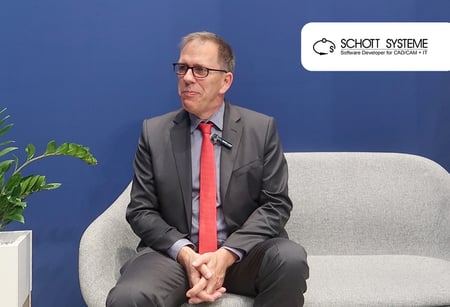
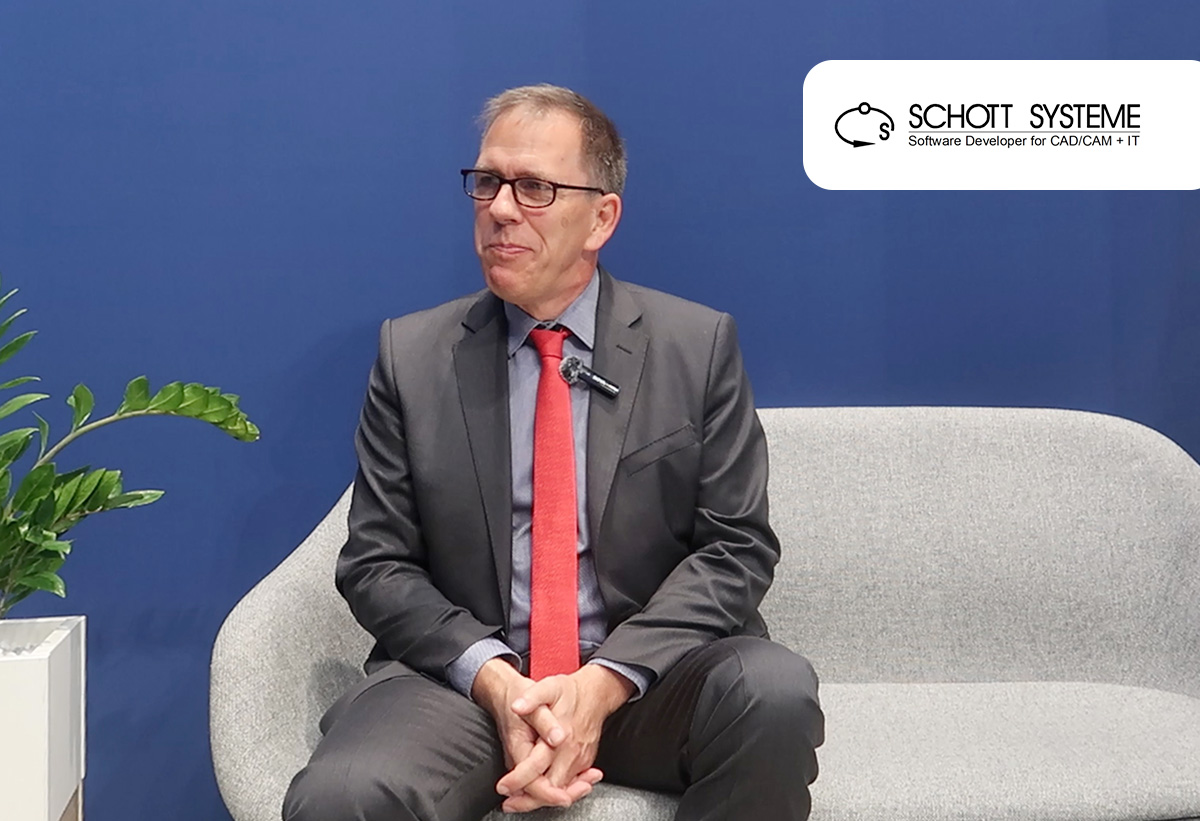

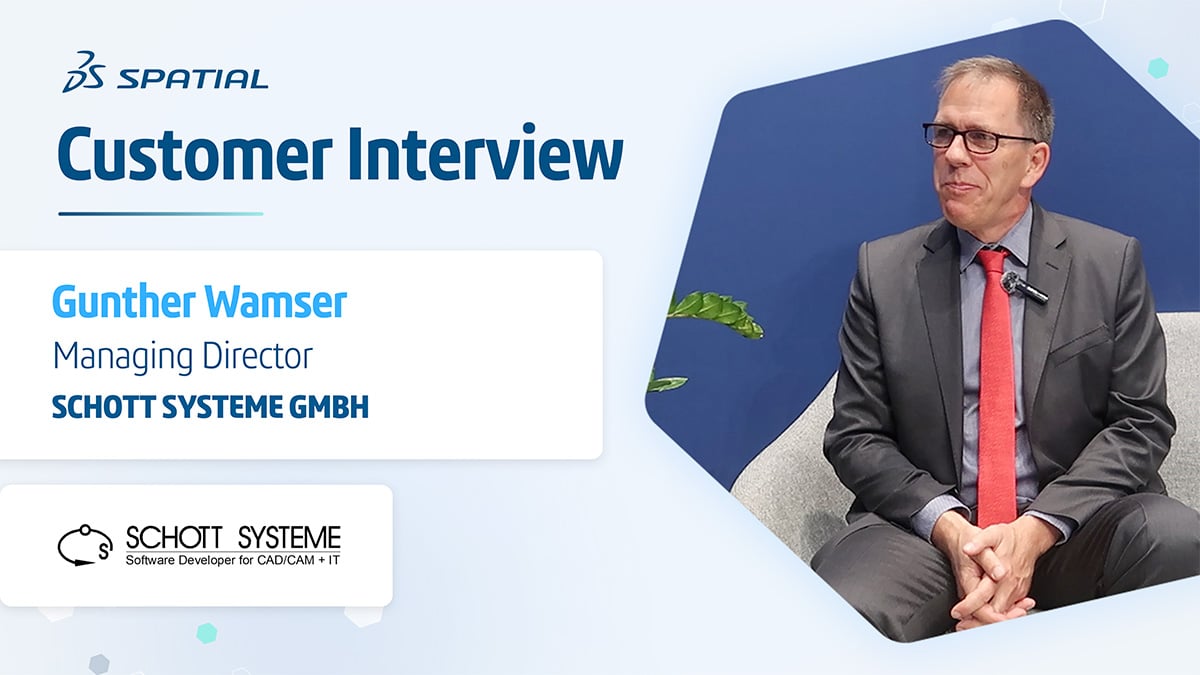
Gunther Wamser, who joined Schott Systeme around 2000 as a software developer and took on the Managing Director role in January 2025, opened with a look back at the company's origins. Founded in 1983 by Mr. Schott and Mr. Greverus, the Munich-based firm started as plotting software for needle printers before evolving into a full CAD/CAM solution — first in 2D, then surface modeling, and eventually 3D volumetric modeling.
With no industry-specific focus, Schott Systeme serves any manufacturer in need of machining software, offering capabilities ranging from basic strategies to high-speed and five-axis milling.
A key turning point came when the CAD market shifted from 2D to 3D. After building their own surface and mesh modelers, the team faced a critical decision: develop a volume modeler in-house or find a technology partner. Lacking the manpower at the time, they turned to Spatial — and have remained customers for 30 years, making them one of Spatial's earliest adopters.
Gunther explained that the ACIS 3D Modeler is the only third-party component in their system, a deliberate choice to retain full control over the rest of their development. The integration proved straightforward: by offloading core 3D modeling functions to Spatial, the team freed up significant time and resources to focus on what matters most — their customers' specific needs.
Looking ahead, Gunther highlighted AI as the most exciting trend on the horizon for the CAD/CAM market. Schott Systeme is already experimenting with automatic milling on prismatic parts, though he acknowledged the technology is still in its early stages.
His advice to companies evaluating geometry kernel partners? Start by clearly defining your requirements — and anticipate that they will evolve. Then engage with Spatial's team early to map out solutions together. A philosophy that has clearly served Schott Systeme well for three decades.
Want to learn more about our CAM capabilities?
- Visit our dedicated CAM industry page, where we explain how we help CAM software editors and machine manufacturer adress their challenges.