 To the uninitiated, 3D printing may seem a simple process — download your CAD file and hit print. But the world of additive manufacturing is more complex. A manufacturer will have to contend with a range of data formats of varying quality (especially if a manufacturer is having to deal with multiple subcontractors for an assembly). This data needs to be correctly translated, made watertight, and made manufacturable — all while retaining design intent. Then a manufacturer needs to combine as many parts as possible to minimize both print time as well as wasted material.
Start-up Looks to Address the Needs of ADDITIVE MANUFACTURING (AM) for Data Preparations
Enter VoxelDance, a Shanghai, China start-up that is looking to bring order to the chaos. The company announced their software solution, Voxeldance Additive, at RAPID+TCT in May. The company’s software solution handles a range of data preparation tasks to ready an assembly for printing:
- CAD file import from a wide range of formats
- Healing (closing holes, removing intersections, wrapping outer faces, etc.) to create watertight entities
- 3D nesting where multiple parts are arranged into box (including constructing a cage around smaller parts) to reduced printer time and sinter powder waste
- Generation of volume, line, bar and point supports
- Editing capabilities to add logos, textures, lattice structures, as well as support for Boolean operations
- Analysis of wall thickness and trapped volumes
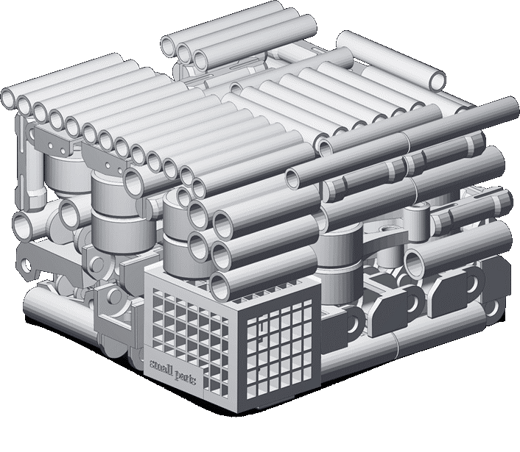 VoxelDance Additive can perform parts nesting in seconds.
The VoxelDance workflow starts with translation — getting accurate data into their environment. While translation is not trivial, it is not part of VoxelDance’s development team’s forte and focus. Rather than devote valuable engineering time to developing and supporting a data translation module, VoxelDance management began a search for third-party solutions. The company quickly chose Spatial’s 3D InterOp the gold-standard for 3D translation.
.png?width=560&name=DOWNLOAD%20FREE%20CASE%20STUDY%20TO%20SEE%20HOW%203D%20INTEROP%20HELPED%20RENISHAWS%20STL%20FILE%20HEALING%20PROCESS%20(1).png)

The Importance of Translation
No solution is an island these days. The ability to correctly import, manipulate and export data is crucial in the world of additive manufacturing. Moreover, problems associated with data exchange may not become apparent until later in the manufacturing process when investigation and correction of problems are more difficult, more costly and require more time. Therefore, a robust translation process is needed.
3D InterOp translates solid (BREP), wire, surface, free surfaces, free curves, and free points. Advanced modeling technology is used in each of the translators to address common data translation differences including, geometry repair, topology repair and tolerance resolution.
Benefits of a Third-Party Solution
Collaborating with Spatial has provided VoxelDance with a robust solution tested on thousands of datasets from hundreds of customers. Moreover, the VoxelDance development team is freed from having to develop and maintain a world-class solution and can focus on their value-add.
VoxelDance benefits from the Spatial engineering team’s more than 30 years of experience in 3D modeling.
Want to learn more about 3D InterOp?

.png?width=450&name=AdobeStock_188705270%20(2).png)

.jpg?width=450&name=Application%20Lifecycle%20Management%20(1).jpg)